I didn't mean to build a homelab, I just wanted my music back.
A simple quest to get my music back became an unexpected journey into self-hosting, ownership and digital sovereignty. This Director's Cut follows every step along the way.
The Slippery Slope of Digital Sovereignty
A shorter version of this essay was published by New Atlas as “I didn't mean to build a homelab, I just wanted my music back”
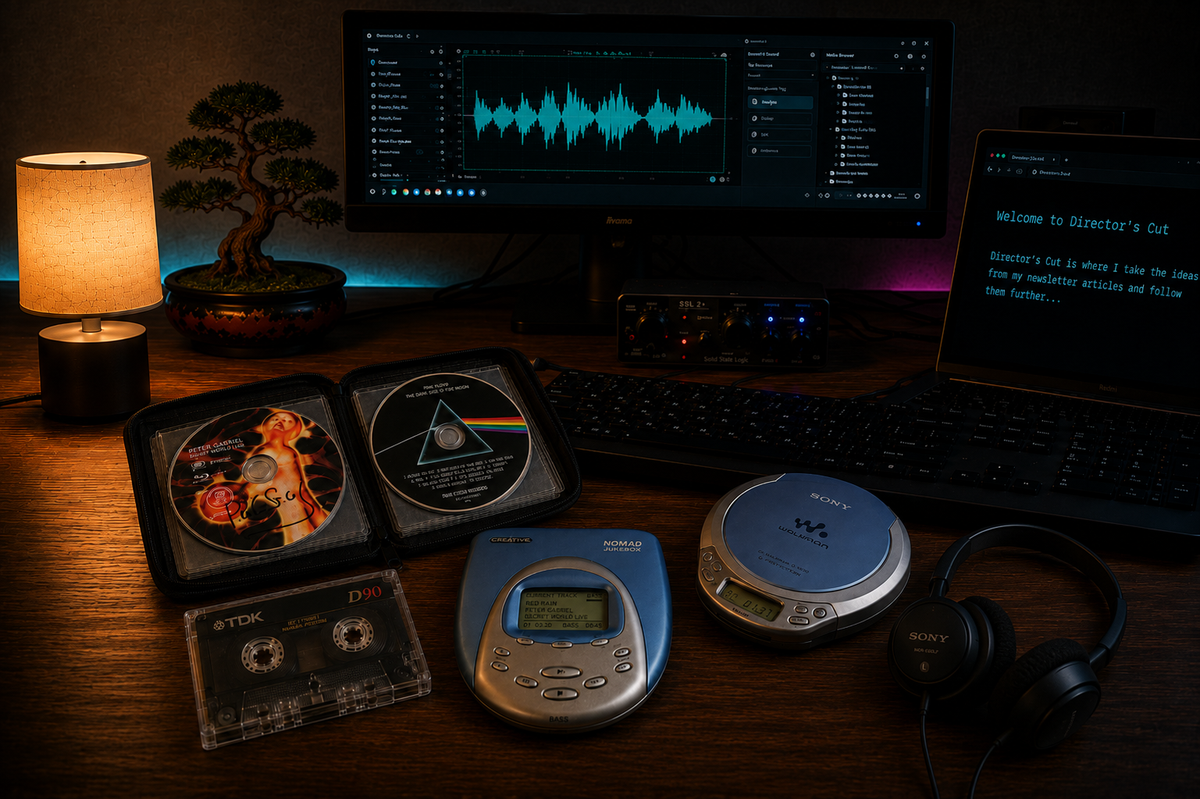
Travelling with music was always a cumbersome affair. Cassettes fluttered, CDs skipped, and choosing a dozen albums for a trip meant leaving dozens more behind. Then there was the one you had to exclude because Peter Gabriel had signed it, and it seemed unnecessarily reckless to expose it to a hot car, a leaking bag or the baggage-handling interpretation of percussion.
There was always compromise. You could have the music you wanted, provided you knew in advance what future-you would want to listen to. You might carefully assemble a travel case containing something energetic, something reflective, something impressive and something those around me could tolerate. Then, three hours down the road, you'd of course suddenly want an album sitting safely at home on the shelf.
Cassettes offered portability, but with hiss, mechanical fragility and the gradual introduction of unintended wow and flutter. CDs fixed much of that, but their shiny precision was not especially well suited to being bounced around in a moving vehicle, or a brisk walk. Portable CD players eventually gained buffers that could absorb a few seconds of vibration, which made jogging with one theoretically possible, although you still looked as though you were carrying a small laboratory instrument and trying not to disturb an experiment.
Then I encountered Fraunhofer’s audio compression work in the mid-1990s.
MP3 hit me like a brick. Here was a way of taking the audio from a compact disc and reducing it to a fraction of its original size while retaining enough quality to make the bargain worthwhile. Storage was expensive and computers were comparatively feeble, but the direction now was suddenly obvious.
I remember thinking, and probably saying to anybody willing to listen, that one day I'd carry my entire music collection around in my pocket.
At the time, this seemed far fetched. My CD collection occupied shelves, boxes and a meaningful percentage of the available domestic storage. The computer on which I began encoding it regarded the process as a serious undertaking. Ripping a substantial collection was not a background task completed while casually checking social media (does Geocities count?) It was a project. It involved patience, naming conventions, metadata, folder structures and a growing suspicion that one slightly scratched disc was going to ruin the afternoon.
I spent weeks doing it.
The result was a digital music collection that occupied tens of gigabytes, and felt enormous at the time. I had taken racks of physical objects and turned them into files. They could be searched, copied and backed up. No moving tape, no skipping disc and no decision about which twelve albums deserved a place in the car.
The future had arrived, albeit tethered to a desktop computer.
That prediction turned out to be correct, although not quite in the way I imagined. What I had not seen coming was how ownership, control and dependence would quietly shift beneath my feet.
A thousand songs in your pocket
The iPod was the first convincing glimpse of the destination. Effectively a Walkman with instant track access, no tape to chew and no optical mechanism to skip. The first model promised a thousand songs in your pocket, which was extraordinary even if a thousand songs was not yet the same thing as an obsessive music collector’s entire library.
I knew the rest would follow. Storage would become smaller and cheaper. Batteries would improve. Portable players would grow. Eventually my entire collection would fit into something I could carry. While my friends were buying Zunes and iPods, I resisted until I found something that 20 something me considered the right balance of affordable and storage. So my first portable MP3 player was the CD Walkman sized Creative Labs Nomad. Six Gb was enough for around 90 albums, so nowhere near my entire collection, but enough for a any likely sojourn.
We were not quite there. You selected what would travel, synchronised the device which remained a ritual, changed your mind and synchronised it again. It was vastly better than carrying CDs, but the old limitation remained in miniature: you still had to predict what you might want.
Capacity increased. Hard drives shrank. Flash storage displaced moving parts. Phones absorbed the functions of cameras, organisers, maps, music players and increasingly large chunks of personal identity. The pocket became the natural home of a computer more capable than the machines I had once used for media production.
Then streaming changed the question.
Well, almost.
Before Spotify, before Apple Music and before anybody had heard the phrase "the cloud," there was a rather chaotic dress rehearsal. In 1999, Napster exploded onto the internet, proving something the music industry had spent years insisting wasn't true: people wanted instant access to music, not just physical ownership of it. Napster itself was short-lived, brought down by legal action, but the genie was out of the bottle. Kazaa, LimeWire, eDonkey and countless others followed, each making it easier to find almost any song you could think of.
The music industry understandably viewed this as rampant piracy. Users often saw something slightly different. For the first time, the internet made music searchable, discoverable and instantly available. The technology was showing people the future, even if the business model was completely wrong.
Eventually, legitimate streaming services arrived and offered something remarkably simple: almost all the convenience of Napster, but legally. Suddenly, millions of songs were available on demand, with decent search, curated playlists and recommendations, all for the price of a couple of CDs each month.
The dream I'd had back in the 1990s had come true, and then some. I hadn't just managed to carry my own music collection around in my pocket; I had access to almost everybody else's as well.
What I had envisaged was carrying my CD collection everywhere. What I got was access to almost every album I could think of, instantly available wherever I happened to be. Not merely my shelves of music, but millions of other shelves too. The obscure mix somebody mentioned in conversation. The album I had sold and later regretted. Five competing recordings of the same symphony. A previously unknown Icelandic composer whose work had been recommended by an algorithm at two in the morning.
It is worth pausing there because this is not an anti-streaming argument. Streaming music is astonishing. The combination of a smartphone and a service such as Spotify or Apple Music delivered something far beyond my teenage expectations. Decades of recorded music became searchable and almost immediately available. Discovery ceased to require a record shop, a specialist radio programme or a friend with unusual tastes and flexible lending policy.
Convenience won because convenience was genuinely better.
It removed friction. It removed the need to decide which music deserved limited storage. It made exploration almost consequence-free. If an album failed to interest me after three tracks, I hadn't wasted 12 quid on it. I could move on. If I became temporarily fascinated by baroque counterpoint or Vietnamese EDM, the catalogue was waiting.
This was not the failure of the technological promise. It was its spectacular fulfilment.
Somewhere along the way, though, something changed. Music stopped being something I owned and became something I accessed. Not overnight, and not necessarily for the worse. The convenience was undeniable.
Most of us barely noticed the trade.
We went from box storage to cloud storage. My CDs disappeared into cupboards while the MP3 files I had spent weeks creating languished on hard drives. Rather than listening to the music I had already bought, preserved and carefully organised, I rented access to another copy of it.
I owned the compact disc. I owned the hardware that had read it. I had done the hard yards of converting it into a portable digital format. Yet the path of least resistance became paying a company each month to provide temporary access to much of the same music.
The subscription was not expensive enough to provoke a crisis. That was part of its effectiveness. It was simply easier. The files were scattered across storage devices and old backups. Their tags were imperfect. Some had been encoded at bitrates I later regarded as inadequate. The streaming service looked cleaner, searched better and followed me automatically from one device to another.
My own collection had become less convenient than the rented version. It would be a while before this grated on me so much I would act.
Close enough to all of it
In 2026, the amount of music I can carry around with me is staggering. How much? Probably all of it. Or close enough to all of it that the distinction hardly matters.
That is not literally every musical sound humanity has produced. Much has never been recorded. Recordings have been lost, destroyed, withheld or left decaying in archives. Local traditions, private performances, unpublished works and obscure physical releases remain beyond the catalogues of global streaming companies.
Nevertheless, from the ordinary listener’s perspective, the scale is almost incomprehensible. Millennia of human music-making endeavour can be summoned from a device in my pocket. Not just the mainstream, but enough historical, regional, experimental and deeply peculiar material to occupy several lifetimes.
Storage is no longer the interesting problem.
Access is.
More specifically: who controls the access?
A subscription does not buy a collection. It buys participation in an arrangement. The service maintains the catalogue, negotiates the licences, supplies the applications and decides which devices remain supported. I pay, and while the arrangement continues, I enjoy extraordinary convenience.
The distinction only becomes visible when something changes.
An album disappears. A version is replaced by a remaster. A service alters its price, interface or terms. An account develops a problem. An internet connection fails. A device becomes unsupported. A company decides that a feature is no longer aligned with its priorities.
None of these possibilities makes streaming inherently bad. It simply means access and ownership are not the same thing.
That difference has spread well beyond music. Films move between services. Television programmes vanish after rights expire. Software that once arrived in a box becomes a recurring charge. Photographs migrate to cloud libraries that are wonderfully searchable but increasingly difficult to imagine leaving. Books can be remotely updated or, in unusual cases, withdrawn. Games depend on servers whose eventual closure has nothing to do with whether the player still enjoys them.
We traded ownership for access, and permanence for convenience.
Again, the arrangement is often reasonable. Running a global service costs money. Artists, developers, storage providers and network operators deserve payment. A subscription may offer much better value than buying everything individually. The point is not that renting is morally inferior to ownership.
The point is that they are different, and the distinction can remain invisible until the rented thing changes beneath you.
Homelab Mk 1
My first serious attempt to take something back was not ideological. I didn't wake up radicalised against cloud computing. I had no manifesto, no rack diagram and no ambition to become the sort of person who holds strong opinions about hypervisors.
I simply wanted my music collection to be as convenient as the subscription.
Nobody wants 200 GB of music occupying most of a phone. Even if the storage is available, copying and maintaining the library is tedious. New albums appear. Metadata changes. Playlists diverge. The phone gets replaced and the entire process begins again.
But the always-on, always-connected device in my pocket did not need to contain the collection. It only needed to reach it.
The files could remain at home on a NAS box. A media server could catalogue them, present them attractively and stream them to whichever device I happened to be using. My music, from my hardware, delivered with much of the convenience I had become accustomed to.
Enter the Raspberry Pi, the NAS and Plex.
The Raspberry Pi was irresistible because it looked like a computer reduced to its underlying idea. It was inexpensive, tiny and just capable enough to encourage experiments. You could attach storage, install software and leave it quietly performing a task without dedicating a full desktop computer to the job.
One Raspberry Pi ran Home Assistant. Another handled Plex. A NAS contained the music. External drives and cables accumulated around them in a configuration that looked less like digital sovereignty and more like an electrical safety training image.
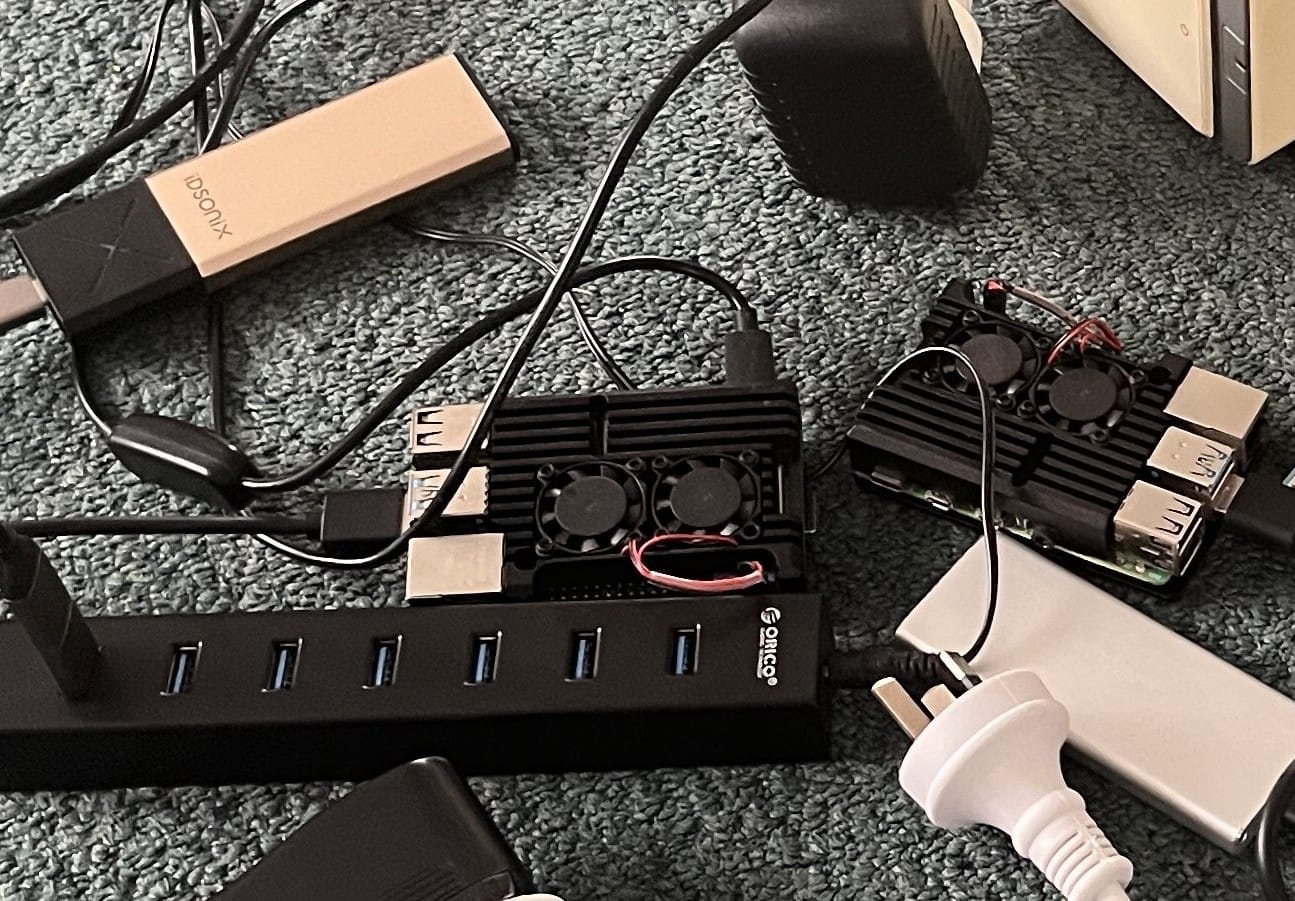
I didn't call it a homelab. I'm not sure I even knew that term. It was simply some equipment solving a collection of small problems. Plex scanned the folders, collected artwork and metadata, and turned my files into something resembling a private streaming service. I could browse albums rather than filenames. I could search, resume and play through a familiar interface.
Most importantly, I could listen to my music from my hardware without sacrificing convenience.
I could blow the pixel dust off the MP3 collection, point the server at it and regain access to work I had completed decades earlier. The files hadn't become obsolete. I'd merely allowed them to become inconvenient.
Without really meaning to, I'd started self-hosting.
I was taking control of my own data before I knew the term “digital sovereignty”. Even now, I use that phrase carefully because it can sound grander than the activity deserves. I was not establishing an independent nation. I was just trying to listen to Secret World without asking a multinational corporation for permission.
Yet the principle was real. The data lived on hardware I controlled. I could organise it, copy it, replace the software that accessed it and continue using it even if a particular commercial service changed direction.
That didn't make me independent of everything. It changed the shape of the dependence.
Ownership is not independence
This is one of the things the shorter article didn't have room to explore.
Self-hosting is often discussed as though it removes dependence. It doesn't. It redistributes it.
When people discover self-hosting, there is a temptation to treat open source as a kind of moral victory. Plex becomes Jellyfin. Google Docs becomes LibreOffice. A cloud AI service becomes a locally hosted model. Problem solved.
Except it isn't.
Open source doesn't eliminate dependency; it changes who you are depending on. Instead of relying on the commercial priorities of a company, you may be relying on the time, enthusiasm and goodwill of volunteers. That's not a criticism. Some of the finest software I use has been built and maintained this way.
But communities are made of people, and people get tired. Maintainers move on. Leadership changes. Burnout happens. The code may remain open indefinitely, but that doesn't guarantee somebody will always be there to improve it, secure it or keep it compatible with everything around it.
Commercial software can disappear because it stops making enough money. Open-source software can stagnate because the people sustaining it eventually need to earn some.
Neither model removes risk. They simply distribute it differently.
My NAS depends on drives, power supplies, network equipment and software updates. The media server depends on operating systems, codecs, applications and client compatibility. Remote access depends on an internet connection at home and wherever I happen to be. If I am away from home and the connection fails, the fact that I own the music is little comfort unless I have also downloaded a local copy.
One reader made exactly this point after the original article appeared: you still require an internet connection to reach a NAS when you are not at home. Another replied that local access continues when the internet fails. Both were correct because they were describing different locations.
At home, the collection remains available over the local network. Away from home, remote streaming depends on connectivity at both ends. A handful of files copied directly to a phone remains the most resilient solution of all. It's just less convenient to curate and maintain.
Another reader asked why anybody needed Plex. Why not open a file manager, select the MP3 and press play?
Again, perfectly reasonable.
You don't need Plex to play an audio file any more than you need a streaming service to play a CD. Plex, Jellyfin and similar provide organisation, metadata, search, artwork, progress tracking, remote access and applications designed for televisions, phones and other devices. They turn folders into a library and a collection into a service.
Whether that's worth the complexity depends on the user.
A person with fifty favourite albums may reasonably copy them to a phone and be finished. Somebody with thousands of albums, films, television programmes, audiobooks, family videos and multiple playback devices encounters a different problem. The file exists, but finding, presenting and resuming it becomes part of the experience.
Self-hosting also costs money.
The subscription may disappear, but electricity, hardware and time do not. Drives fail. Backups require more storage. Software changes. A configuration that worked perfectly for three years can break because one component updates before another. Future hardware may not support the software you chose. Open-source projects can stagnate or become abandoned and commercial products can pivot.
Digital sovereignty is not freedom from maintenance. It is the decision to accept more responsibility in exchange for more control.
That trade can be worthwhile, but pretending it's free does nobody any favours.
The hidden currency is attention.
A streaming subscriber pays money and delegates most of the maintenance. A self-hoster pays for equipment and spends time learning, configuring, repairing and updating. The result may be cheaper over a long period, or it may not. My own arrangement has grown far beyond anything that could honestly be defended as a money-saving exercise.
I have admittedly gone extras because I am a nerd and a techie.
The return isn't purely financial. I like solving the problems. I like understanding how the pieces interact. There is satisfaction in knowing that a service exists because I assembled it, and that I can change it when it no longer suits me.
That enjoyment is part of the calculation. If maintaining servers feels like unpaid labour, subscribing may be the more rational choice. If it feels like an absorbing hobby that also provides useful services, the arithmetic changes.
The slippery slope
The trouble with solving one ownership problem is that it makes the others more visible.
Once the NAS existed, it became the obvious place for photographs. Family pictures were spread across computers, phones, memory cards and old backup drives, even clouds. Consolidating them seemed sensible.
Once the photographs were on the NAS, they needed backing up. A NAS is storage, not magic. A failed disk, accidental deletion, electrical event, theft or fire can still remove the data. Redundancy helps with hardware failure, but it doesn't replace a backup. The system therefore acquired more storage and more processes.
Audiobooks followed. Then films. Then television programmes. Then ebooks, documents and recordings.
That thing that happened to music, as it moved from physical to virtual, had happened to almost every form of media I cared about. The boxes were disappearing, but the desire to retain the contents remained.
We were gonna to need a bigger NAS.
A Raspberry Pi became two Raspberry Pis, then a mini PC. Separate services appeared because different problems wanted different tools. Home Assistant managed lights, sensors and automations. Media servers organised entertainment. Backup systems copied important data. Other applications replaced cloud services whose convenience I wanted without necessarily wanting the dependency that accompanied them.
Eventually, I discovered virtualisation and Proxmox’d everything onto a proper server.
That sentence makes the progression sound more deliberate than it was. There was no architectural master plan. The infrastructure grew around whatever problem I happened to be solving. One device was added because an existing device was overworked. One service was separated because an update broke something else. One backup became two because the first backup was sitting uncomfortably close to the original.
Somewhere along the way, I found myself running virtual machines, containers, local AI models and a selection of self-hosted services. There were dashboards showing the state of other dashboards. A monitoring system watched the systems that watched the house. The network gained names, diagrams and increasingly strong opinions about where particular devices should be allowed to communicate.
At no point did I decide to build a homelab.
I just sort of drifted here.
That drift is common because each individual step seems reasonable. You buy a NAS for files. You add a media server because folders are ugly. You install Home Assistant because the manufacturer’s smart-home application is dreadful. You create a backup because losing everything would be catastrophic. You add another machine because one service needs more power. You virtualise because the collection of little machines has become difficult to manage.
Then one day you look around the office and realise you are running a small data centre because you wanted to listen to some CDs.
Plex, Jellyfin and logging in to reach your own things
Plex was central to making personal media convenient, which is why changes to Plex provoke unusually strong reactions. People don't merely use it as another entertainment service. They use it as the front door to collections they've spent years building.
That distinction matters.
Plex combines personal media software with commercial services and a centrally managed account system. For many people, that creates a polished experience across phones, televisions and remote connections. It handles much of the complexity that would otherwise make self-hosting unattractive.
For others, the prospect of logging into an external service to reach files sitting on hardware a few metres away feels philosophically wrong.
I’m hardly alone in noticing the tension. As Plex has moved further towards subscriptions, advertising and centrally managed services, a growing number of self-hosters have begun keeping Jellyfin running alongside it—or leaving Plex altogether.
One Linux podcaster recently expressed the sentiment more colourfully than I'll reproduce here. The gist was that requiring external authentication to access your own collection sits uncomfortably with the idea of ownership.
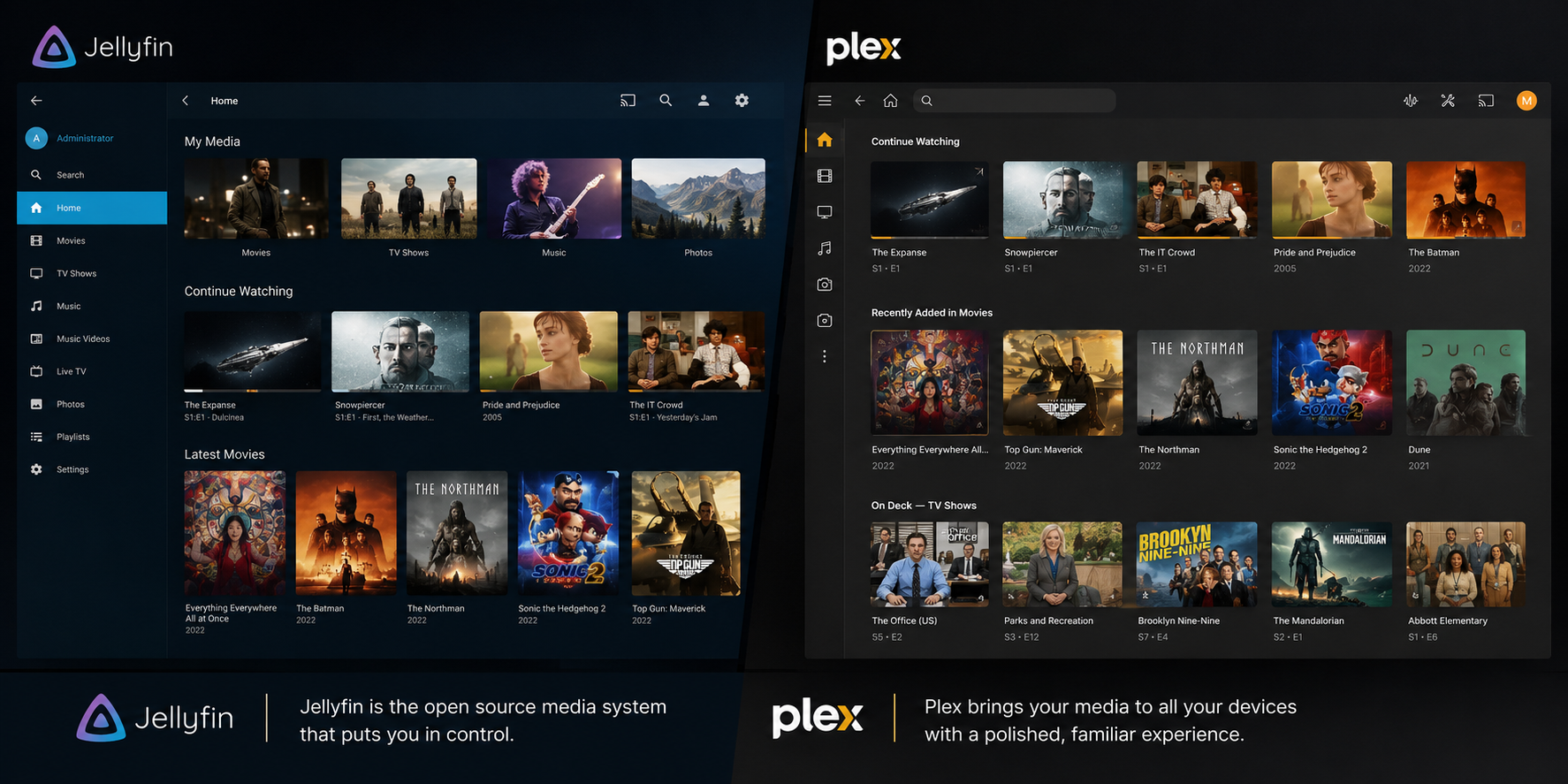
This is one reason Jellyfin is adored by many self-hosters. It is free and open source, can operate locally and places control more directly with the person running the server. It's also one reason Jellyfin can demand more from that person. The polish, compatibility and ease of remote access may differ depending on the device and configuration. Control and convenience continue negotiating with each other.
The extraordinary rise announced for the price of a new lifetime Plex Pass sharpened the discussion. It was not simply a question of whether the new price represented good value. It reminded users that even software built around personal media remains a platform, and platforms change.
Prices change.
Terms change.
Ownership does not.
Or, more accurately, ownership changes less. A hard drive can fail, a format can age and a collection can become difficult to use, but the company providing the interface can't remove the underlying files if those files remain under your control.
That's why the arguments become emotional. Plex may be the software through which a person has experienced their collection for a decade. It may be installed on every television in the house and used by family members who neither know nor care where the files live. Replacing it isn't merely installing an alternative application. It means disturbing an established domestic habit.
Convenience creates attachment.
That is not a criticism. Good technology should disappear into routine. But once it does, changing it becomes expensive in a currency that has little to do with licence fees: disruption.
The broader question remains the one that led me back to my music collection in the first place.
How much of our digital lives are we comfortable placing on somebody else’s platform?
There's no universal answer. I use commercial cloud services. I subscribe to things. I depend on companies whose infrastructure I couldn't hope to reproduce. I have not achieved, and don't particularly desire, some monastic state of technological independence.
I simply want to make those dependencies consciously.
When convenience wins anyway
The clearest example didn't involve entertainment.
During a medical appointment, I was asked to consent to an AI transcription system processing the consultation. The attraction was obvious. Rather than dividing his attention between me and a keyboard, the doctor could hold a conversation while the system generated notes.
This is precisely the sort of AI application that deserves serious consideration. Administrative work consumes clinical time. Anything that returns attention to the patient has potential value.
It also meant allowing a deeply personal conversation to be captured and processed by a system I knew little about.
I hesitated and initially declined.
The practical response was that the consultation would not proceed without it. I could wait weeks to see another doctor who might work differently, or I could accept the system and receive care that day.
Convenience won.
That phrase can sound flippant when applied to healthcare, but the underlying choice was real. Privacy had not ceased to matter. I had not suddenly concluded that all AI processing was harmless. The immediate need simply outweighed the more abstract concern.
Real life is full of such compromises.
This is why digital sovereignty can't be reduced to “host everything yourself” or “reject the cloud”. Most people lack the time, money, interest or expertise to recreate every service they use. Even those of us with racks of equipment still rely on telecommunications networks, software projects, manufacturers, certificate authorities, domain registrars, operating systems and electricity grids.
The goal isn't perfect independence. Perfect independence I think is largely fictional.
The useful goal is agency: understanding that a trade exists, deciding which side of it matters in a particular situation and retaining alternatives where the cost is reasonable.
For music, the alternative was affordable and enjoyable. I already owned the files. A NAS and media server restored access without requiring heroic sacrifice.
For urgent medical care, the alternative was weeks of delay.
Different problem, different answer.
That doesn't make the underlying questions disappear. It makes them more important because rules such as “never allow cloud processing” collapse the moment reality becomes inconvenient enough. Meaningful control requires options, transparency and the ability to understand what is being exchanged.
Consent offered without a practical alternative may be legally recognisable, but it doesn't feel much like choice.
That story belongs in a larger discussion about AI, privacy and the distinction between storing data and processing it. It didn't fit comfortably into the shorter music article, but it complicates the argument in a useful way. I'm not retreating from modern technology. I'm using it enthusiastically while trying to remain awake to what it asks in return.
The growing middle ground
This is not an argument that everyone should buy servers.
Many people are perfectly served by Apple Music, Spotify, Netflix, Google Photos and the countless other services that turn technical complexity into a monthly fee. They provide good value, and for somebody with no interest in maintaining infrastructure, they may be the most sensible option.
Nor does digital ownership require a rack full of enterprise equipment.
There's a growing middle ground between surrendering everything to subscriptions and reconstructing the internet in your spare bedroom.
A NAS. A mini PC. A sensible backup. A few carefully chosen self-hosted services. Perhaps local storage for the files that genuinely matter and cloud services for the things that don't.
Modern hardware makes this far more approachable than it once was. A small, efficient computer can run services that previously demanded loud, power-hungry equipment. Friendly interfaces and containerised applications reduce some of the pain. Communities document solutions, answer questions and occasionally argue for seventeen pages about the correct way to name a folder.
You don't need a PhD, a data centre or 5 grands worth of gear.
You do need to decide how much responsibility you want.
Self-hosting can restore control, but control creates chores. Updates must be applied. Backups must be tested. Remote access must be secured. Hardware must eventually be replaced. The collection needs stewardship.
That is the part enthusiasts sometimes omit when recommending the lifestyle. They talk about escaping subscriptions but not about spending Sunday afternoon repairing a database because a container update interacted badly with a permissions change.
The correct amount of self-hosting is not “everything”.
It is the amount whose benefits continue to exceed its burden.
For me, music easily passed that test. Photographs and important documents did too. Home automation became worthwhile because it solved real problems and operated locally when the internet was unavailable (if your hardware is carefully chosen). Other experiments have been installed, admired and removed because they created more administration than value.
Digital sovereignty is a slippery slope, but it doesn't have to be a one-way descent. You can climb back up. You can decide that a service is better left to professionals. You can subscribe again. You can keep local copies of some things and rent access to others.
The point is not ideological purity.
The point is remembering that there's a choice.
What was the music actually for?
There is another tension lurking behind the abundance.
In the cassette era, choosing twelve albums for a journey was frustrating, but the limitation also gave those albums weight. You listened repeatedly because they were what you had brought. Living with an album meant giving it time. You didn't just consume it; you got to know it.
Infinite access changes listening as well as ownership.
When almost everything is available, any moment of boredom can be answered by something else. The cost of abandoning an album approaches zero. Discovery expands, but attention fragments. A catalogue containing most of recorded music doesn't automatically produce a richer relationship with music.
It can produce indecision.
I occasionally spend longer searching for something to hear than I would once have spent changing a CD. The technology has removed the physical friction while introducing a psychological one: with almost every option available, why choose this one?
My own library helps partly because it has boundaries. It represents choices accumulated over decades. Browsing it is not the same as searching a global service. These are albums I bought, inherited, or deliberately kept. The collection says something about my history, including things I no longer particularly like but can't quite bring myself to delete.
Ownership creates curation.
A streaming library can be curated too, of course. Playlists, favourites and listening histories build a personal layer on top of the global catalogue. But that layer exists inside another company’s system - their cloud. The collection is partly mine and partly an interpretation of me maintained by a service.
There is value in having a pile of files that doesn't try to predict what I want next.
No recommendation engine. No engagement target. No new release promoted because a label paid for visibility or because millions of other listeners behaved in a statistically and algorithmically compelling way.
Just music.
Sometimes the practical benefit of ownership is not resilience or cost. It's peace.
Thirty years later
Looking back, I was right about carrying my music collection around in my pocket.
The files are not physically inside the phone, but that distinction is largely technical. From almost anywhere, I can reach a collection stored at home. I can also reach a commercial catalogue so vast that 8 year old me would have thought it magic.
Technology delivered exactly what I hoped for.
What I failed to predict was that the fulfilment of the dream would change the relationship between ownership, control and dependence. The music would become more available than ever while the mechanism of access moved further away from me.
Taking one small piece back didn't reverse the modern world. It didn't free me from corporations, networks or software maintenance. It didn't make streaming unnecessary or subscriptions immoral.
It simply restored an option.
If Plex changes, the files remain. If Jellyfin suits me better, I can move. If the internet fails while I'm at home, the local network still works. If I want guaranteed access while travelling, I can put some music directly on the phone like a sensible person and avoid writing 4,000 words about it.
The homelab that followed was not the objective. It was the accumulated consequence of repeatedly asking the same question:
Could I keep the convenience while reclaiming some control?
Sometimes the answer was yes. Sometimes it was technically yes but practically ridiculous. Sometimes the cloud remained the better option. The useful part was recognising that convenience and ownership are not opposites so much as variables. Each service places them differently, and each person will draw the line in a different place.
Recent changes in platforms, pricing and authentication have encouraged more people to look at that line. Not because the cloud has failed, but because it has become so central to ordinary life that our dependence is easier to see.
Perhaps that's the real slippery slope.
Not that one Raspberry Pi inevitably leads to a server rack, although experience suggests there is some risk of that.
It is that once you notice the bargain in one part of your digital life, you begin seeing it everywhere.
The music subscription.
The photo library.
The smart-home cloud.
The software licence.
The AI assistant.
The medical transcription system.
The convenient service that works beautifully, right up until the terms change or the connection disappears.
You don't need to reject any of them. You just need to know which parts of your life they hold, what you receive in return and whether you retain a way out.
Thirty years after imagining my music collection in my pocket, I now have a NAS, backups, virtual machines, local AI and enough network infrastructure to make a simple diagram look accusatory.
I certainly didn't set out to build a homelab.
I just wanted my music back.
Read the shorter published version at New Atlas.
Enjoyed this Director’s Cut?
If you’d like to support the writing, audio production and experiments behind the site, you can leave a tip.